Read the statement by Michael Teeuw here.
AI Coding Tools Infuse a new Life in MagicMirror
-
AI Coding Tools Infuse a New Life in MagicMirror
But before that; a word of caution, PLEASE, Please know what you are doing, take backups.
Over the past few months, I decided to revisit my MagicMirror setup, and the transformation has been substantial. What was once a stable but slowly evolving dashboard has now become a far more dynamic, optimized, and feature-rich system, largely due to the practical use of modern AI coding tools. Previously, extending or modifying MagicMirror modules required significant time for debugging, documentation review, and iterative testing. While that process was valuable, it often slowed experimentation. With AI-assisted development, I was able to accelerate module customization, refactor legacy configurations, improve styling consistency, and resolve dependency conflicts far more efficiently. Some of the key improvements included:
- Refactoring older custom modules for cleaner, maintainable code
- Optimizing API integrations for faster data refresh cycles
- Improving CSS layout responsiveness and visual structure
- Enhancing module intercommunication logic
- Automating repetitive configuration adjustments
- Generating code for new Modules, customised to my requirements and setup
- Tight integration with Homeassistant
AI tools proved especially effective when troubleshooting obscure npm issues, adjusting Node.js compatibility problems, and restructuring asynchronous logic. Instead of spending hours isolating minor errors, I could focus on architectural improvements and feature expansion.
The result is a significantly more responsive, visually refined, and modular MagicMirror installation—essentially a complete recharge of the system without starting from scratch.
AI coding tools are not a replacement for understanding the underlying architecture, but they are undeniably powerful accelerators. For anyone maintaining or expanding a MagicMirror instance, integrating AI into the workflow can dramatically reduce friction and unlock creative possibilities.
It has effectively given my MagicMirror a second life. I am currently using, Claude Desktop with Sonnet 4.6, Openclaw, AgentZero . All these provide direct integration with MagicMirror and modify code and configurations directly.
FInally remember PLEASE be careful and know what you are doing.
-
@Rags very cool.
I am using the cline integration (Sonnet 4.6) with VS to enhance some firmware (build env in VS), and its been interesting.
the task session is of limited size, and once the size is exceeded, we start a WHOLE new topic, with no memory of any prior one… so have to RELEARN some environmental and design decisions… wasting time and task space on old stuff…
but its amazing what a few hours can do…
-
@sdetweil Amazing. My current setup has MagicMirror and Homeassistant running on the home network. The integrations between the two is like a Portal has opened up between the future and the past. It is almost like the AI (Alien) visits the past and resolves issues, I guess it is time for the community to harness the power of AI (Cautiously of course) and make MagicMirror a truly user friendly project which can benefit the people who have no tech/ coding background , and would need something that repairs itself when broke.
-
@Rags there is a lot of content…
my MMM-Config tries to remove the config.js editing , and put all the config in one place.
and lately adding modules from the 3rd party list in one place.I’m not UI guy, so its not fancy/modern UI. (but customizable some via css)
as I’m sure you found, the consistency of the MM UI depends on the combined UI experience of all the module developers. quite a challenge. and the see thruness to allow for separate background content poses some unique challenges…
but still, its amazing how fast one can get content up on display, with very little traditional developer skill.
-
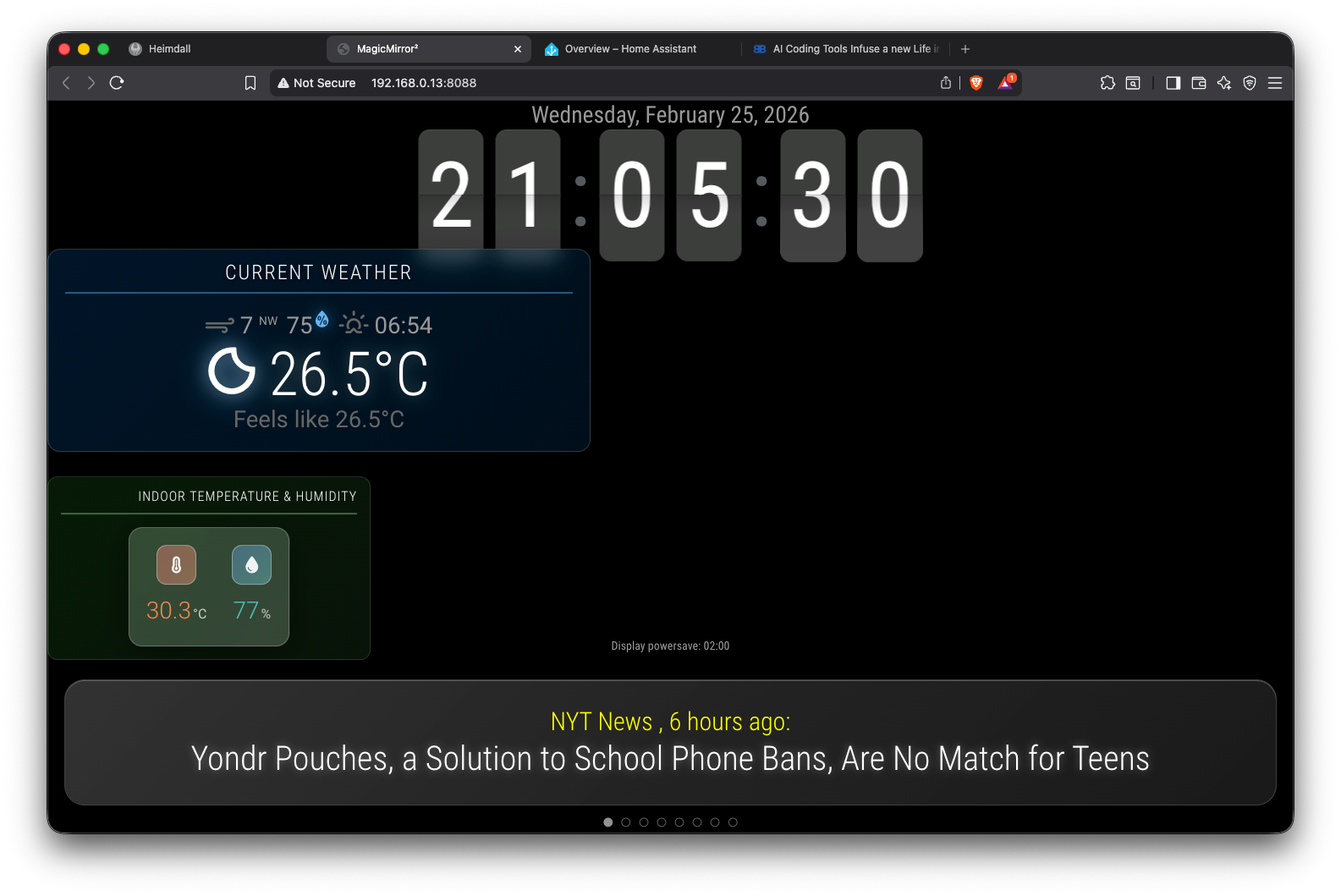
@sdetweil I agree. Just to make a point I used AI to rewrite .css code for some of the modules to enhance the UI display on the screen. I achieved the Glass Morphism display characteristics, which is the latest in IOS
-
@Rags interesting!
-
I am using the cline integration (Sonnet 4.6) with VS to enhance some firmware (build env in VS), and its been interesting.
I‘m using claude code - installed directly on Mirror‘s RasPi and it (mostly :-) ) works like a charm.
Indeed you need a subscription and several times „auto compressions“ of the current chat happens.
But if one insist in writing important information consequently to CLAUDE.md as well as to „memory“ even every fresh started session has pretty much context…Warm regards,
Ralf -
@rkorell That is so encouraging.
-
@Rags yes, it is :-)
Hello! It looks like you're interested in this conversation, but you don't have an account yet.
Getting fed up of having to scroll through the same posts each visit? When you register for an account, you'll always come back to exactly where you were before, and choose to be notified of new replies (either via email, or push notification). You'll also be able to save bookmarks and upvote posts to show your appreciation to other community members.
With your input, this post could be even better 💗
Register Login