Read the statement by Michael Teeuw here.
Help Translating Word Clock
-
I’m going through the process of translating my word clock module, and I’m using the existing German, Dutch, and Swedish translations for MMM-TextClock as a starting point. However, these seem to be quite literal translations of the English, and I’m not positive that they make sense in context when read by a native speaker of the language.
For example, here is the english version:
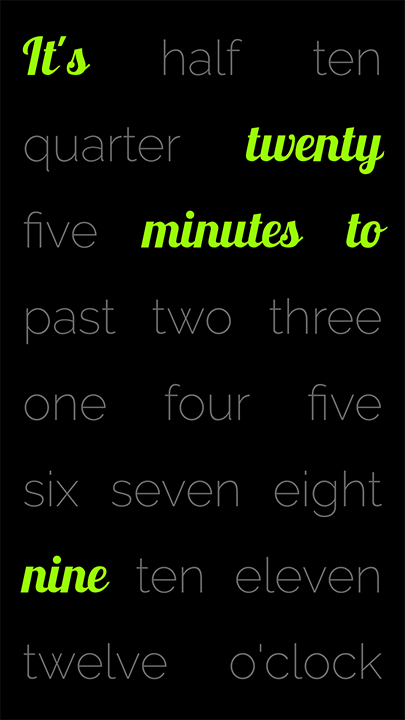
Now, a direct translation to dutch:
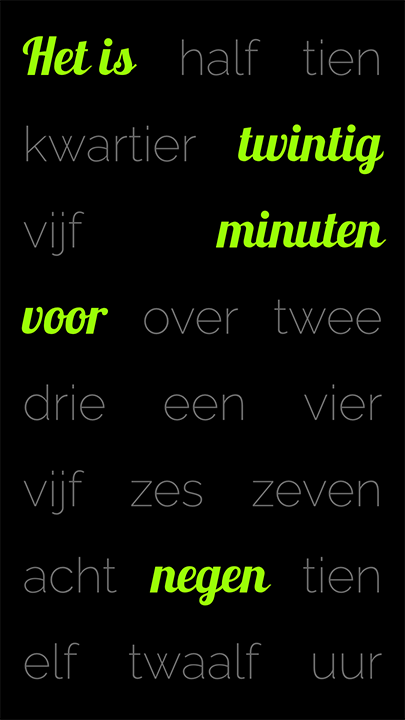
Does this make sense in context?
Hopefully German, Swedish, and Dutch speakers can help here:
My first thought is that in Europe generally people use 24-hour time; while my clock is based on 12-hour time. Does the above make sense or should it have hours 13 through 23? How about at “00:00”? How would one say “It’s midnight?”
Secondly, in English we say “It’s half past six,” but in WWW-TextClock it reads for all languages “It’s half seven”. Is it typical to reference the next hour at the half (e.g.: It’s half seven)? Or should it be like the english version (e.g.: It’s half past six)?
Finally it would help if someone could translate the following sentences in each of the above languages (assume these refers to 1:00 PM and 2:00 PM, so if these should be represented in 24hr time, then please translate as such).
- It’s one o’clock
- It’s five minutes past one
- It’s quarter past one
- It’s half past one
- It’s twenty-five minutes to two
- It’s quarter to two
- It’s ten minutes to two
I believe I have enough words from MMM-TextClock to complete the rest for DE, NL, and SV in 12hr time, but I would need the hour names from 13:00 to 23:00 in order to use 24hr time.
If someone would like to provide me with translations for other languages, please answer the above questions, and I would need translations in five minute increments for how one would typically articulate the time in words through a whole hour. Plus I would need the names of all of the hours, 1 through twelve for 12hr time, 0 through 23 for 24hr time.
e.g.:
-
It’s one o’clock
-
It’s five minutes past one
-
It’s ten minutes past one
-
It’s quarter past one
-
It’s twenty minutes past one
-
It’s twenty-five minutes past one
-
It’s half past one
-
It’s twenty-five minutes to two
-
It’s twenty minutes to two
-
it’s quarter to two
-
It’s ten minutes to two
-
It’s five minutes to two
-
It’s eleven o’clock (both 11:00 and 23:00)
-
It’s twelve o’clock (both 00:00 and 12:00)
-
It’s one o’clock (both 01:00 and 13:00)
-
etc for each hour.
Any help is extremely appreciated. I really would like to have good translations in my module, and not simply a direct translation from the English that may or may not be contextually correct.
Thanks in advance!
-Jeff -
@j.e.f.f said in Help Translating Word Clock:
MMM-TextClock
I did the Dutch translation.
I thought there was an error in displaying the time (words) in the right order for Dutch and an error in displaying the right hours at a specific time. I will have a look in my notes and come back to you with the results after I gave it a test run.{ "ITIS": "HET IS", "HALF": "HALF", "QUARTER": "KWART", "MINUTES": "MINUTEN", "TO": "VOOR", "PAST": "OVER", "ONE": "EEN", "TWO": "TWEE", "THREE": "DRIE", "FOUR": "VIER", "FIVE": "VIJF", "SIX": "ZES", "SEVEN": "ZEVEN", "EIGHT": "ACHT", "NINE": "NEGEN ", "TEN": "TIEN", "ELEVEN": "ELF", "TWELVE": "TWAALF", "TWENTY": "TWINTIG", "OCLOCK": "UUR", "THIRTEEN": "DERTIEN", "FORTEEN": "VEERTIEN", "FIFTEEN": "VIJFTIEN", "SIXTEEN": "ZESTIEN", "SEVENTEEN": "ZEVENTIEN", "EIGHTEEN": "ACHTTIEN", "NINETEEN": "NEGENTIEN", "THIRTY": "DERTIG", "FORTY": "VEERTIG", "FIFTY": "VIJFTIG", "OH": "OH", "HUNDRED": "HONDERD", "ZERO": "NUL" }Thats the translation I have, now to your questions;
- 12 or 24 hour Clock, In the Netherlands we use the 12-hour clock when we read it out. So leave it as it is.
- To midnight we just say its 12 o’clock or midnight (middernacht)
- At half past six (06:30) in Dutch we speak this out as ‘it’s half seven’ (het is half zeven)
The translations for the asked times;
-
It’s one o’clock --> Het is een uur (01:00)
-
It’s five minutes past one --> Het is vijf (minuten) over een (01:05)
-
It’s quarter past one --> Het is kwart over een (01:15)
-
It’s half past one --> het is half twee (01:30)
-
It’s twenty-five minutes to two --> Het is vijf (minuten) over half twee (01:35)
-
It’s quarter to two --> Het is kwart voor twee (01:45)
-
It’s ten minutes to two --> Het tien (minuten) voor twee (01:50)
-
It’s one o’clock --> Het is een uur (01:00)
-
It’s five minutes past one --> Het is vijf (minuten) over een (01:05)
-
It’s ten minutes past one --> Het is tien (minuten) over een (01:10)
-
It’s quarter past one --> Het is kwart over een (01:15)
-
It’s twenty minutes past one --> Het is tien (minuten) voor half twee (01:20)
-
It’s twenty-five minutes past one --> Het is vijf (minuten) voor half twee (01:25)
-
It’s half past one --> Het is half twee (01:30)
-
It’s twenty-five minutes to two --> Het is vijf (minuten) over half twee (01:35)
-
It’s twenty minutes to two --> Het is tien (minuten) over half twee (01:40)
-
it’s quarter to two --> Het is kwart voor twee (01:45)
-
It’s ten minutes to two --> Het is tien (minuten) voor twee (01:50)
-
It’s five minutes to two --> Het is vijf (minuten) voor twee (01:55)
Normaly we leave the minutes away when we say the time in Dutch, thats why I put them in brackets ()
- It’s one o’clock (both 01:00 and 13:00) – > Het is een uur
- It’s two o’clock (both 02:00 and 14:00) – > Het is twee uur
- It’s three o’clock (both 03:00 and 15:00) – > Het is drie uur
- It’s four o’clock (both 04:00 and 16:00) – > Het is vier uur
- It’s five o’clock (both 05:00 and 17:00) – > Het is vijf uur
- It’s six o’clock (both 06:00 and 18:00) – > Het is zes uur
- It’s seven o’clock (both 07:00 and 19:00) – > Het is zeven uur
- It’s eight o’clock (both 08:00 and 20:00) – > Het is acht uur
- It’s nine o’clock (both 09:00 and 21:00) – > Het is negen uur
- It’s ten o’clock (both 10:00 and 22:00) – > Het is tien uur
- It’s eleven o’clock (both 11:00 and 23:00) --> Het is elf uur
- It’s twelve o’clock (both 00:00 and 12:00) --> Het is twaalf uur
Hope this is a start, when you have question please ask.
-
Funny, I just started making a module like this myself yesterday because there was none. Looks very good so far.
12-hour based makes more sense. I solved it by adding two numbers below the clock, 12 and 24. When the hour is less or equal than 12, 12 is lit and if it’s greater than 12 lit up 24 (if that makes any sense).
I can show a screenshot of my module if you are interested.
-
@pjkoeleman This is wonderful! Thank you very much. I’ll work this in this evening and post a few screenshots.
-
@Ultimatum22 Heh! There was already an existing one – MMM-TextClock – before I started mine. It is very good, but not exactly what I was looking for, hence why I wrote my own. Interested to see how yours turns out.
Nice to have three to choose from!
-
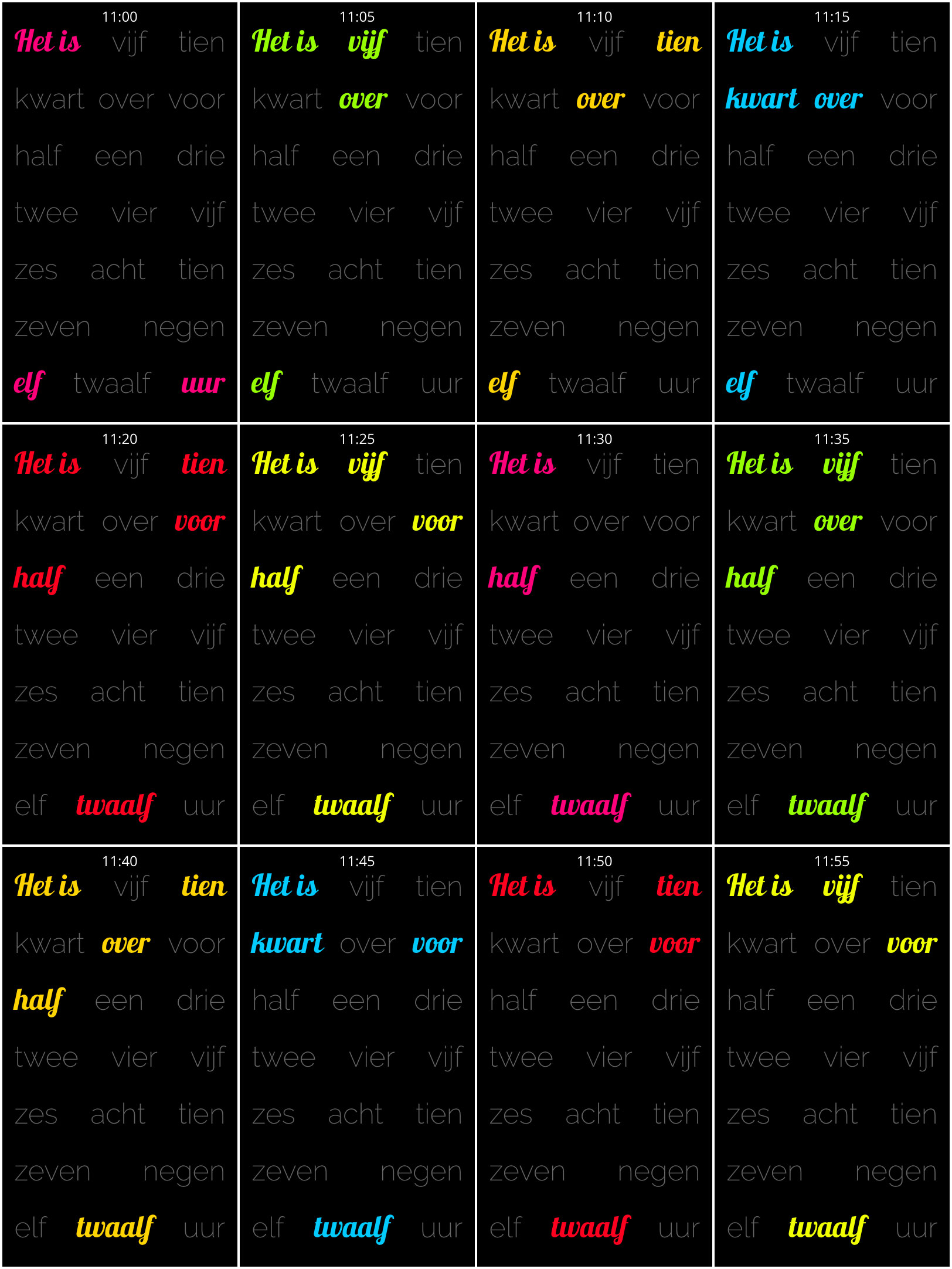
@pjkoeleman I had a few minutes, so I threw this together real quick. How does it look to you?
-
@j-e-f-f
That is looking very very good!
I can only spot one minor issue. There is two times the Five (vijf) and two times the Ten (tien) in the image.Stupid of me these is nessesary for de hourly times, sorry
-
@pjkoeleman Heh! No worries. Thanks for verifying. Hopefully others can help with the other languages.
-
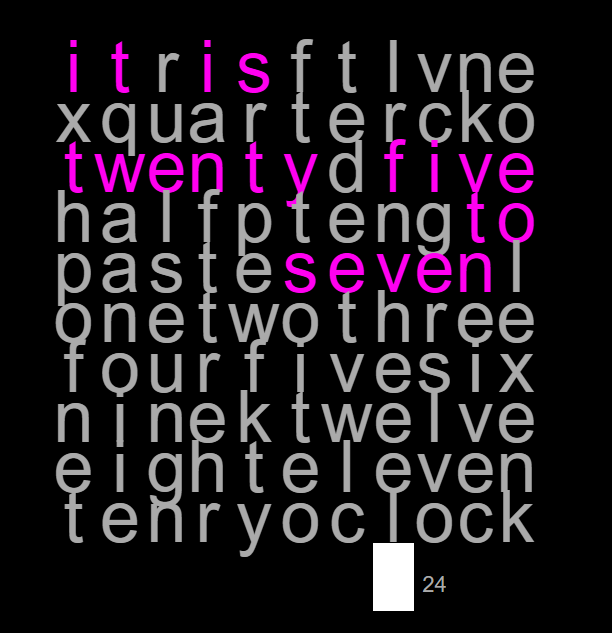
I didn’t found that other module, thanks for pointing it out.
This is what I got so far, still a work in progress. The white square is supposed to be the rest minutes.
-
I join my predecessor @pjkoeleman
German Translation:
{
 "ITIS": "Es ist",
 "HALF": "halb",
 "QUARTER": "viertel",
 "MINUTES": "Minuten",
 "TO": "vor",
 "PAST": "nach",
 "ONE": "eins",
 "TWO": "zwei",
 "THREE": "drei",
 "FOUR": "vier",
 "FIVE": "fünf",
 "SIX": "sechs",
 "SEVEN": "sieben",
 "EIGHT": "acht",
 "NINE": "neun ",
 "TEN": "zehn",
 "ELEVEN": "elf",
 "TWELVE": "zwölf",
 "TWENTY": "zwanzig",
 "OCLOCK": "Uhr",
 "THIRTEEN": "dreizehn",
 "FORTEEN": "vierzehn",
 "FIFTEEN": "fünfzehn",
 "SIXTEEN": "sechzehn",
 "SEVENTEEN": "siebenzehn",
 "EIGHTEEN": "achtzehn",
 "NINETEEN": "neunzehn",
 "THIRTY": "dreißig",
 "FORTY": "dierzig",
 "FIFTY": "fünfzig",
 "OH": "0?",
 "HUNDRED": "hundert",
 "ZERO": "null"
}
It’s one o’clock -> Es ist ein Uhr
It’s five minutes past one -> Es ist fünf nach eins (more common) / Es ist fünf nach ein Uhr
It’s ten minutes past one -> Es ist zehn nach eins (more common) / … ein Uhr
It’s quarter past one -> regional different: “Es ist viertel zwei” - “Es ist viertel nach eins / … ein Uhr”
It’s twenty minutes past one -> Es ist zwanzig Minuten nach eins / … ein Uhr
It’s twenty-five minutes past one -> Es ist fünfundzwanzig Minuten nach eins / Es ist fünf vor halb zwei (more common)
It’s half past one -> Es ist halb zwei (rounded up to next full hour)
It’s twenty-five minutes to two -> Es ist fünfunfzwanzig Minuten vor zwei / Es ist fünf nach halb 2 zwei (more common)
It’s twenty minutes to two -> Es ist zwanzig Minuten vor zwei / Es ist zehn nach halb 2 (more common)
it’s quarter to two -> regional differenz: “Es ist dreiviertel zwei” - “Es ist viertel vor zwei Uhr”
It’s ten minutes to two -> Es ist zehn Minuten vor zwei Uhr
It’s five minutes to two -> Es ist 5 Minuten vor zwei Uhr
It’s eleven o’clock (both 11:00 and 23:00) -> Es ist elf Uhr // Es ist dreiundzwanzig Uhr
It’s twelve o’clock (both 00:00 and 12:00) -> Es ist null Uhr // Es ist zwölf Uhr
It’s one o’clock (both 01:00 and 13:00) -> Es ist ein Uhr / Es ist dreizehn Uhr
Normaly we leave the “minutes” and “o’clock” away, like saying time in Dutch.
If you need more details, please ask. -
@clubbi Thank you! I’ll be adding this tonight along with a French translation.
One question: I notice a small difference in the first example:
It’s five minutes past one -> Es ist fünf nach eins (more common) / Es ist fünf nach ein Uhr
in the second example, there is no “s” at the end on “ein”. Does this mean when it’s on the hour (e.g.: 1:00) one would say “Es ist ein Uhr”, but when the word “Uhr” is not used, there is an “s”? (e.g.: “Es ist fünf nach eins”). Is the case for any other hours? I noticed it wasn’t for “Es ist fünfunfzwanzig Minuten vor zwei”
Also, is “Uhr” always capitalized? e.g.: would “Es ist elf uhr” be incorrect?
Cheers!
-
@j.e.f.f In German the additional “s” is only relevant for the number 1. So without “Uhr” the “s” is required and with a sentence with “Uhr” the “s” must be omitted.
“Uhr” is always capitalized. So your example “Es ist elf uhr” is incorrect. -
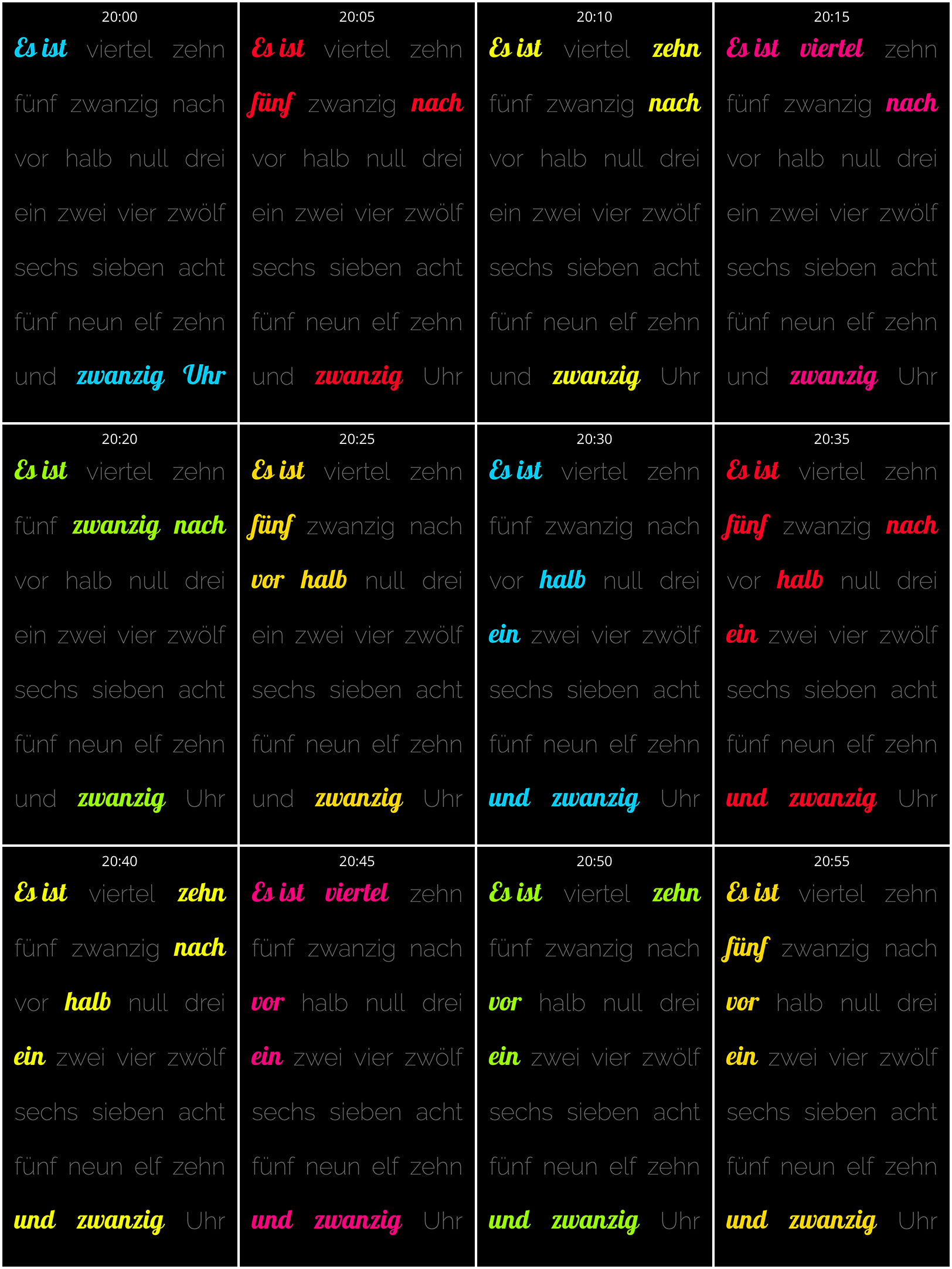
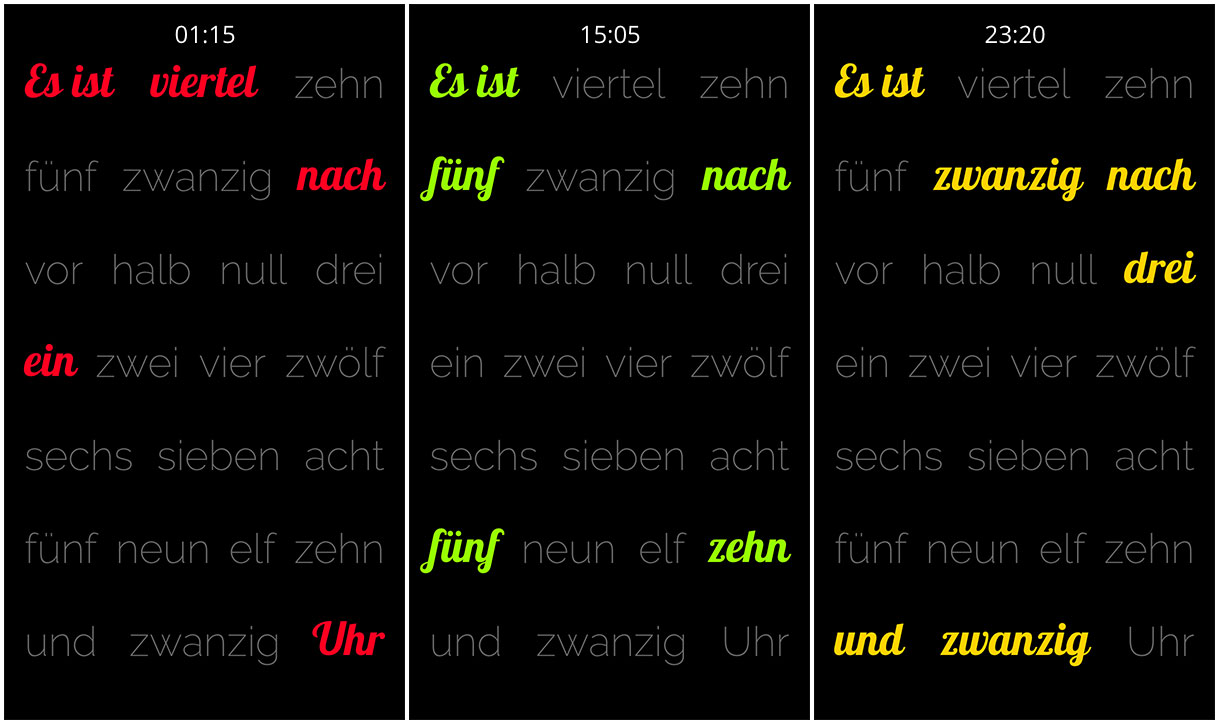
@clubbi @willfri OK here’s my attempt at making a German translation:
There were complications with having both “ein” and “eins” in the grid. So to avoid a special code case, for all times from 01:00 through 01:55, I always end with the word “Uhr.” I don’t do this for any other hours though… should I?
I took some creative license with displaying hours 13:00 through 19:00, as well as hours 21:00 through 23:00.
See both screenshots below for examples, and let me know if my translation works.
-
@j.e.f.f
First of all, German is not my main language, but there are some things I see.- 20:25 “Es ist fünf vor halb zwanzig” should be “Es ist fünf vor halb neun”, I would never use the “zwanzig” wenn I write the time like this or speak about the actual time.
- 20:30 is now written as “Es ist halb ein und zwanzig”. I think that has to be like in Dutch “Es ist halb neun”. Dutch and German look a lot the same.
- 20:35 schould be “Es ist fünf nach halb neun”
- 20:40 schould be “Es ist zehn nach halb neun”
- 20:45 schould be “Es ist viertel vor neun”
- 20:50 schould be “Es ist zehn vor neun”
- 20:55 schould be “Es ist fünf vor neun”
The use of “zwanzig” is strange in my opinion, but let some German speaking users decide how they want it to be.
-
@pjkoeleman it was my impression based @clubbi 's translation suggestion that the clock should show 24 hour time, which is why it is laid out as such.
@clubbi @willfri should this be a 24 hour clock or a 12 hour? Also note that it’s possible to have layouts for both styles, so I could add a German 12 hour clock in addition to keeping the current 24 hour layout.
-
@j.e.f.f How @pjkoeleman said I would also prefer a 12 hour layout because all times after 12 sounds strange in German.
Use “Uhr” only when it’s xx:00. The example at 01:15 should be “Es ist viertel nach eins”. So it would be better if you could find a solution for “ein” and “eins” because it sounds much better.
Some examples for better understanding:
- 00:30/12:30 “Es ist halb eins”
- 01:00/13:00 “Es ist ein Uhr” (use “ein” only here)
- 01:05/13:05 “Es ist fünf nach eins”
- 01:15/13:15 “Es ist viertel nach eins”
-
@willfri Thanks! A twelve-hour clock is easier for me to layout as well, so it looks like I’ll go that route. I’ve been thinking about a good way to handle the “s” on the end of “ein” and I think I have a good solution in mind that won’t be a special case just for the German layout.
I’ll post back new screenshots when I make the change.
-
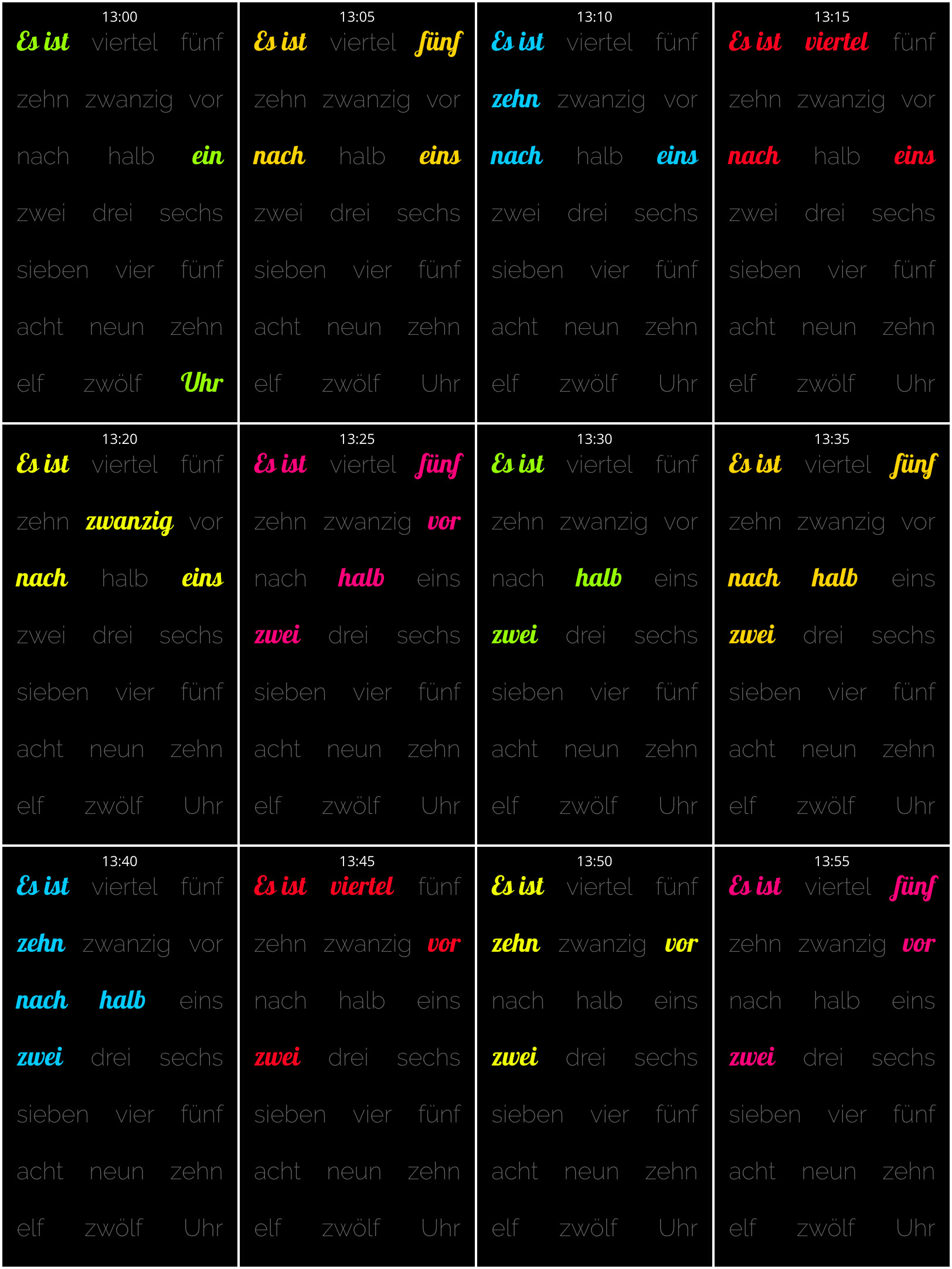
@willfri OK. Here is the German layout, now using a 12 hour clock. I have it properly displaying
ein/eins" in context.Question: Since we’re using 12 hour time instead of 24, is it customary to specify what part of the day it’s in? For example, in the French translation, it would say “Il est cinq heures du matin,” or “It’s five o’clock in the morning.” Similarly you’d append “de l’après midi” for the afternoon, and “du soir” for in the evening.
-
@j.e.f.f
I think that is awesome, for a Dutch person. -
@j.e.f.f said in Help Translating Word Clock:
Question: Since we’re using 12 hour time instead of 24, is it customary to specify what part of the day it’s in? For example, in the French translation, it would say “Il est cinq heures du matin,” or “It’s five o’clock in the morning.” Similarly you’d append “de l’après midi” for the afternoon, and “du soir” for in the evening.
I’m not sure if it’s needing. In German it would be
- Night: “Es ist zwei Uhr nachts”
- Morning: “Es ist sieben Uhr morgens”
- Afternoon: “Es ist drei Uhr nachmittags”
- Evening: “Es ist neun Uhr abends”
But for the other times without “Uhr” it sounds in my opinion wired: “Es ist viertel nach zwei nachts”
I don’t know how other German people see it.

Hello! It looks like you're interested in this conversation, but you don't have an account yet.
Getting fed up of having to scroll through the same posts each visit? When you register for an account, you'll always come back to exactly where you were before, and choose to be notified of new replies (either via email, or push notification). You'll also be able to save bookmarks and upvote posts to show your appreciation to other community members.
With your input, this post could be even better 💗
Register Login