MagicMirror Forum
    • Recent
    • Tags
    • Unsolved
    • Solved
    • MagicMirror² Repository
    • Documentation
    • 3rd-Party-Modules
    • Donate
    • Discord
    • Register
    • Login
    A New Chapter for MagicMirror: The Community Takes the Lead
    Read the statement by Michael Teeuw here.

    Help Translating Word Clock

    Scheduled Pinned Locked Moved Requests
    66 Posts 10 Posters 54.1k Views 10 Watching
    Loading More Posts
    • Oldest to Newest
    • Newest to Oldest
    • Most Votes
    Reply
    • Reply as topic
    Log in to reply
    This topic has been deleted. Only users with topic management privileges can see it.
    • pjkoelemanP Offline
      pjkoeleman
      last edited by

      @willfri @strawberry-3-141
      Is the translation of 13:20 okee, I would say “Es ist zehn vor halb zwei”?

      W 1 Reply Last reply Reply Quote 1
      • J Offline
        j.e.f.f Project Sponsor Module Developer @strawberry 3.141
        last edited by

        @strawberry-3.141 This is amazing! Thanks for this. Let me know when the tall version is available and I’ll merge it in

        1 Reply Last reply Reply Quote 0
        • W Offline
          willfri @pjkoeleman
          last edited by

          @pjkoeleman Yes, “Es ist zehn vor halb zwei” would be better as “Es ist zwanzig nach eins”

          pjkoelemanP 1 Reply Last reply Reply Quote 1
          • pjkoelemanP Offline
            pjkoeleman @willfri
            last edited by

            @willfri
            Then we have to ask @j-e-f-f if he will changes this in the German language.

            Disclamer : Ich bin nur hier, um mein Deutsch zu üben.

            J 1 Reply Last reply Reply Quote 0
            • ? Offline
              A Former User
              last edited by

              I am ashamed to tell this, I’m living in Germany for years but cannot speak any Deutsche. :)

              You can see this.
              https://learn-german-easily.com/tell-time-in-german

              J 1 Reply Last reply Reply Quote 0
              • J Offline
                j.e.f.f Project Sponsor Module Developer @pjkoeleman
                last edited by

                @pjkoeleman Yep I’ll take care of this. Thanks for pointing this out!

                1 Reply Last reply Reply Quote 0
                • J Offline
                  j.e.f.f Project Sponsor Module Developer @Guest
                  last edited by

                  @Sean From the link you sent, it appears that “Viertel” should always be capitalized, much like “Uhr.”

                  @willfri @strawberry-3-141 is that the case?

                  ? 1 Reply Last reply Reply Quote 0
                  • ? Offline
                    A Former User @j.e.f.f
                    last edited by A Former User

                    @j.e.f.f said in Help Translating Word Clock:

                    @Sean From the link you sent, it appears that “Viertel” should always be capitalized, much like “Uhr.”

                    Viertel is a noun. viertel is an adjective. All nouns begin with capital in German.

                    Additionally,
                    Eins is a feminine-noun. It means ‘number 1’
                    eins is a numeral, but varied form. The root form is ein. eins is used as neutral-noun when used alone without any other subjective. So, eins is shorten from ein Uhr. One more funny thing, Uhr is feminine-noun, so eine Uhr means a clock not an hour

                    1 Reply Last reply Reply Quote 0
                    • J Offline
                      j.e.f.f Project Sponsor Module Developer
                      last edited by

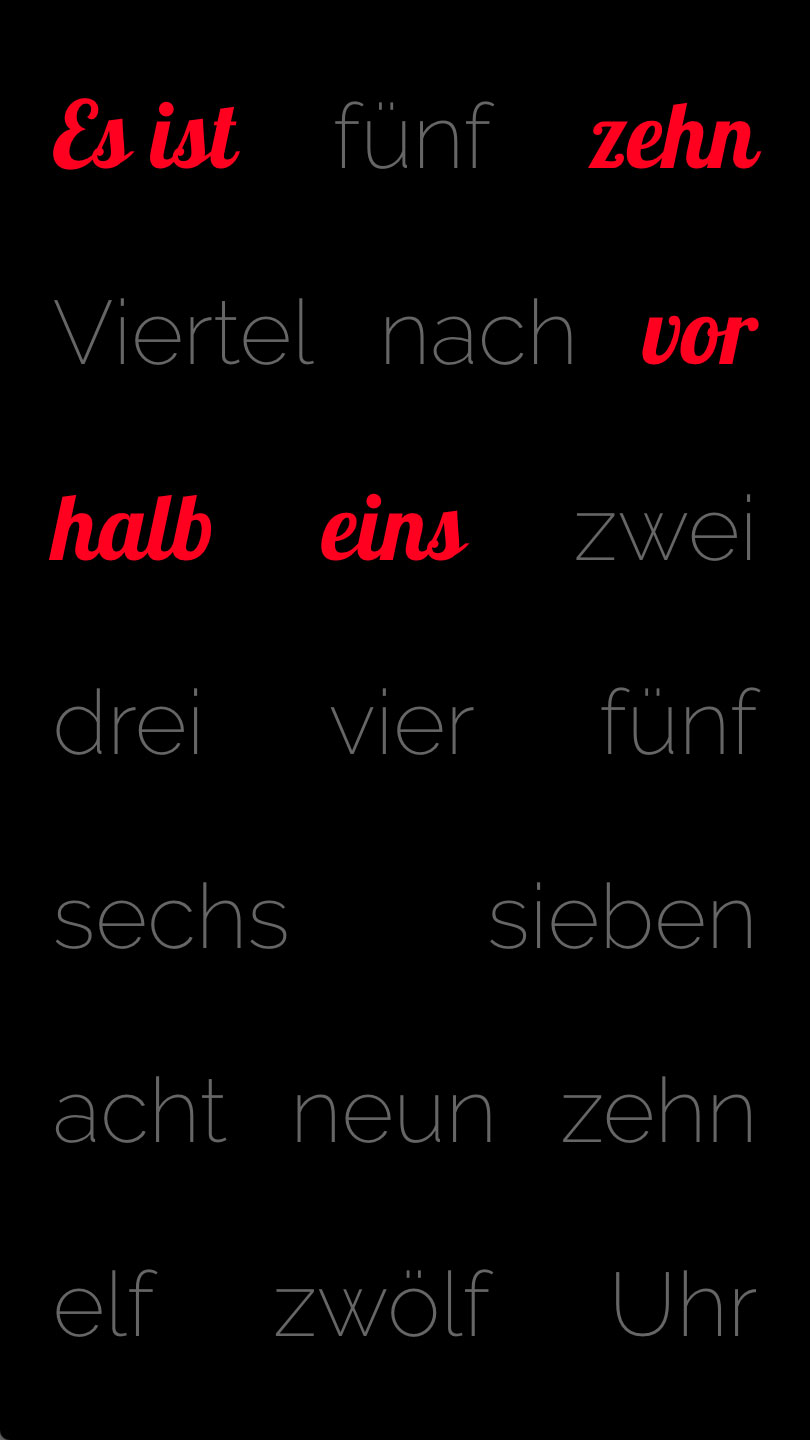
                      I just pushed an update to correct the German layout. Here’s an example:
                      0_1503073498252_updated_de_example.jpg

                      1 Reply Last reply Reply Quote 0
                      • kruemelK Offline
                        kruemel
                        last edited by kruemel

                        erm… sounds strange to me (Switzerland)
                        We say: “Es ist zwanzig nach zwölf”
                        or “es ist fünf vor halb eins”

                        or “es ist fünf nach eins”
                        or “es ist zwanzig vor eins”

                        but nobody here says “zehn vor halb eins”

                        … complicated this world languages, everybody talks different :D

                        ? 1 Reply Last reply Reply Quote 0
                        • ? Offline
                          A Former User @kruemel
                          last edited by A Former User

                          :D
                          In Standarddeutsch(Hochdeutsch),
                          08:20

                          • Es ist zwanzig nach acht.
                          • Es ist zehn vor halb neun.
                            both are available. (Also, zwanzig vor = zehn nach halb)

                          How about this?
                          08:15

                          • Es ist Viertel nach acht.
                          • Es ist viertel acht.

                          And in some southern German, even this is available.

                          09:45

                          • Es ist drei viertel neun.

                          09:40

                          • Es ist fünf Minuten vor drei viertel neun.

                          That is why I dropped my German lesson. :)

                          strawberry 3.141S 1 Reply Last reply Reply Quote 0
                          • strawberry 3.141S Offline
                            strawberry 3.141 Project Sponsor Module Developer @Guest
                            last edited by

                            @Sean the first is correct zwanzig vor = zehn nach halb

                            the second is incorrect

                            08:15
                            Es ist Viertel nach acht.
                            Es ist viertel acht.
                            

                            It is either Es ist viertel nach acht or Es ist viertel neun, but Es ist viertel acht would be 07:15.

                            The next is also correct

                            09:45
                            Es ist drei viertel neun.
                            

                            And the last would be theoretically correct as well, but I really never heard someone saying this.

                            09:40
                            Es ist fünf Minuten vor drei viertel neun.
                            

                            German is probably one of the hardest languages to learn for foreigners.

                            Please create a github issue if you need help, so I can keep track

                            ? 1 Reply Last reply Reply Quote 0
                            • ? Offline
                              A Former User @strawberry 3.141
                              last edited by A Former User

                              @strawberry-3.141 ^^ I was confused.^^ anyway, whether i’m living in Germany for several years as foreigner, Deutsche is verry difficult to learn. The only phrase I can speak is “Bitte? Leider ist meine Deutsche nicht so gut, Kennen Sie Engilsch sprechen?” :P

                              @j-e-f-f Do you have any interest about Far-East-Asian version for your clock? For Korean, Japanese and Chinese I can help you for the schemes of word clock with proper characters. They are probably easier than Indian-European languages. And even shorter and less exception.
                              Maybe it’s not useful for most users, but it could be pretty beautiful.

                              J 1 Reply Last reply Reply Quote 0
                              • J Offline
                                j.e.f.f Project Sponsor Module Developer @Guest
                                last edited by

                                @Sean that would be amazing! I don’t think the fonts I’m using support double-byte characters though. I’ll have to check. I might need to source other fonts for these.

                                ? 2 Replies Last reply Reply Quote 0
                                • ? Offline
                                  A Former User @j.e.f.f
                                  last edited by

                                  @j.e.f.f noto font from google could be possible in raspbian. With my experience, people should install additional fonts for CJK supports like noto.

                                  J 1 Reply Last reply Reply Quote 0
                                  • J Offline
                                    j.e.f.f Project Sponsor Module Developer @Guest
                                    last edited by

                                    @Sean no need. If it’s available in google fonts then I can include it with the module. That’s what I’m doing now.

                                    I need two fonts. One for the I highlighted state, which should be a rather plain version, and one for the highlighted state which should be ornamental.

                                    ? 1 Reply Last reply Reply Quote 0
                                    • ? Offline
                                      A Former User @j.e.f.f
                                      last edited by A Former User

                                      @j.e.f.f Traditionally, sanserif and serif would fit.
                                      In a few days, I’ll send you whole scheme for CJK.

                                      1 Reply Last reply Reply Quote 0
                                      • L Offline
                                        Lange
                                        last edited by

                                        In Denmark we use 12-hour clock when we read out.
                                        At midnight we use only midnight (midnat)
                                        At half past six (06:30) we use “It is halv six” (Den er halv seks)

                                        It’s one o’clock --> Den er et (01:00)
                                        It’s five minutes past one --> Den er fem minutter over et (01:05)
                                        It’s quarter past one --> Den er kvart over et (01:15)
                                        It’s half past one --> Den er halv to (01:30)
                                        It’s twenty-five minutes to two --> Den er femogtyve minutter i to (01:35)
                                        It’s quarter to two --> Den er kvart i to (01:45)
                                        It’s ten minutes to two --> Den er ti minutter i to (01:50)
                                        It’s one o’clock --> Den er et (01:00)
                                        It’s five minutes past one --> Den er fem minutter over et (01:05)
                                        It’s ten minutes past one --> Den er ti minutter over et (01:10)
                                        It’s quarter past one --> Den er kvart over et (01:15)
                                        It’s twenty minutes past one --> Den er tyve minutter over et (01:20)
                                        It’s twenty-five minutes past one --> Den er femogtyve minutter over et (01:25)
                                        It’s half past one --> Den er halv to (01:30)
                                        It’s twenty-five minutes to two --> Den er femogtyve minutter i to (01:35)
                                        It’s twenty minutes to two --> Den er tyve minutter i to (01:40)
                                        it’s quarter to two --> Den er kvart i to (01:45)
                                        It’s ten minutes to two --> Den er ti minutter i to (01:50)
                                        It’s five minutes to two --> Den er 5 minutter i to (01:55)

                                        If asked about the time we say “Den er” (It is) but if we give the information in we would normally say “Klokken er” (The time is) - I have used “Den er” in this translation, but “Klokken er” is also very useable
                                        We dont use anything after a full hour “Den er et” or “Klokken er et” would be “Its one o’clock”

                                        Let me know if I can do anything for you, this was just a quick translation

                                        {
                                         "ITIS": "DEN ER",
                                         "HALF": "HALV",
                                         "QUARTER": "KVART",
                                         "MINUTES": "MINUTTER",
                                         "TO": "I",
                                         "PAST": "OVER",
                                         "ONE": "ET",
                                         "TWO": "TO",
                                         "THREE": "TRE",
                                         "FOUR": "FIRE",
                                         "FIVE": "FEM",
                                         "SIX": "SEKS",
                                         "SEVEN": "SYV",
                                         "EIGHT": "OTTE",
                                         "NINE": "NI",
                                         "TEN": "TI",
                                         "ELEVEN": "ELLEVE",
                                         "TWELVE": "TOLV",
                                         "TWENTY": "TYVE",
                                         "OCLOCK": "NOT-USED",
                                         "THIRTEEN": "TRETTEN",
                                         "FORTEEN": "FJORTEN",
                                         "FIFTEEN": "FEMTEN",
                                         "SIXTEEN": "SEKSTEN",
                                         "SEVENTEEN": "SYTTEN",
                                         "EIGHTEEN": "ATTEN",
                                         "NINETEEN": "NITTEN",
                                         "THIRTY": "TYVE",
                                         "FORTY": "FYRRE",
                                         "FIFTY": "HALVTREDS",
                                         "OH": "OH",
                                         "HUNDRED": "HUNDREDE",
                                         "ZERO": "NUL"
                                        }
                                        
                                        J 1 Reply Last reply Reply Quote 0
                                        • A Offline
                                          Atteraxol
                                          last edited by

                                          @j-e-f-f I found this german word clock. Could be a help for the layout of the words.

                                          J 1 Reply Last reply Reply Quote 0
                                          • ? Offline
                                            A Former User @j.e.f.f
                                            last edited by A Former User

                                            @j.e.f.f

                                            word clock for CJK

                                            If you cannot see characters of this document in your browser properly, tell me please. (In that case, you should install CJK fonts like Google Noto)

                                            General

                                            • Chinese, Japanese, Korean fonts are composited by multi-byte characters
                                            • They use 12H system, but in military, science and public service, 24H system is also used.
                                            • In 24H system, they use 00 hour, but usually in 12H system, they call it 12 hour.
                                              e.g) 12:10 is called pm 12:10, 00:10 is called am 12:10.
                                            • Traditionally they use dawn-morning-daylight-evening-night time slot system, but the borders between slots are very ambiguous, therefore am and pm system is more normally used nowadays.
                                            • Unlike the known, Chinese, Japanese and Korean are not kin-languages. They have no embryological and lingual relation each other. But they shared so many words because they had used same characters historically.
                                            • Chinese and Japanese don’t use whitespace between words, but Korean do. However, You don’t need to consider that point in wordclock.
                                            • They read numbers as 10-based decimal digits not 12-based duodenary like Western. And they read numbers from left to right always without exception.
                                            • in CJK, reading multi-digits numbers are based on 10-digits multiplication.
                                              So, from 1 to 9 is just read as 1 - 9, and 10 is 1 * 10, 100 is 1 * 100 and you can calcluate how it goes. (e.g. 123 is 1*100 + 2 * 1*10 + 3)
                                            number Chinese Japanese Korean
                                            1 一 一 일
                                            10 (1 * 10) 十 十 십
                                            11 (1 * 10) + 1 十一 十一 십일
                                            12 (1 * 10) + 2 十二 十二 십이
                                            20 2 * (1 * 10) 二十 二十 이십
                                            21 2 * (1 * 10) + 1 二十一 二十一 이십일

                                            Japanese

                                            The only serious problem is that Japanese KANJI(borrowed characters from Chinese) string could be read differently in each context. However, We don’t need to consider how the text is read and pronounced. ^^; It’s none of our business.
                                            They don’t use white spaces between words, but in this document, I add space for your understanding.

                                            Japanese clock scheme

                                            Simplest Version

                                            {
                                              'timeslot' : {'午前', '午後'}, // 'am', 'pm'
                                              '10hour' : {'十'}, // '1*10' 
                                              'under10hour' : {'一', '二', '三', '四', '五', '六', '七', '八', '九'}, // '1', '2', '3', '4', '5', '6', '7', '8', '9'
                                              'hoursymbol' : {'時'}, // 'hour'
                                              'over10min' : {'二', '三', '四', '五'}, // '2', '3', '4', '5'
                                              '10min' : {'十'}, // '1*10'
                                              'each5min' : {'五'}, // '5'
                                              'minutesymbol' : {'分'}, // 'minute'
                                            }
                                            

                                            example)
                                            am 01:00 => 午前 一 時
                                            am 02:05 => 午前 二 時 五 分
                                            am 03:10 => 午前 三 時 十 分
                                            am 04:15 => 午前 四 時 十 五 分
                                            am 05:20 => 午前 五 時 二 十 分
                                            am 06:25 => 午前 六 時 二 十 五 分
                                            pm 07:30 => 午後 七 時 三 十 分
                                            pm 08:35 => 午後 八 時 三 十 五 分
                                            pm 09:40 => 午後 九 時 四 十 分
                                            pm 10:45 => 午後 十 時 四 十 五 分
                                            pm 11:50 => 午後 十 一 時 五 十 分
                                            pm 12:55 => 午後 十 二 時 五 十 五 分
                                            That’s all.

                                            Is it too easy? Here is more formal version.
                                            Formal Version

                                            {
                                              'phrasestart' : {'今は'}, // 'Now, it is...'
                                              'timeslot' : {'午前', '午後'}, // 'am', 'pm'
                                              '10hour' : {'十'}, // '1*10' 
                                              'under10hour' : {'一', '二', '三', '四', '五', '六', '七', '八', '九'}, // '1', '2', '3', '4', '5', '6', '7', '8', '9'
                                              'hoursymbol' : {'時'}, // 'hour'
                                              'justat' : {'定刻'}, // 'just, sharp at hour'
                                              'halfhour' : {'半'}, // 30min
                                              'over10min' : {'二', '三', '四', '五'}, // '2', '3', '4', '5'
                                              '10min' : {'十'}, // '1*10'
                                              'each5min' : {'五'}, // '5'
                                              'minutesymbol' : {'分'}, // 'minute'
                                              'before' : {'前'}, // to use XX min before hour
                                              'phraseend' : {'です。'}, // ending symbol of phrase
                                            }
                                            
                                            • You can add '今は' and 'です。' for making full sentence.
                                              It is am 02:05. => 今は 午前 二 時 五 分 です。
                                            • You can use '定刻' after hoursymbol for displaying ‘just at hour’.
                                              It is exactly am 01:00. => 今は 午前 一 時 定刻 です。
                                            • You can use '半' for displaying half-hour.
                                              It is pm 07:30. => 今は 午後 七 時 三 十 分 です。 => 今は 午後 七 時 半 です。
                                            • You can use '前' for small minutes before hour. (usually below 15 minutes)
                                              5 mins before => '五分前'
                                              10 mins before => '十分前'
                                              15 mins before => '十五分前'
                                              It is pm 10:45. => 今は 午後 十 時 四 十 五 分 です。 => 今は 午後 十 一 時 十 五 分 前 です。

                                            Korean

                                            It is same with the formal Japanese version, but with Korean own characters.

                                            {
                                              'phrasestart' : {'지금은'}, // 'Now, it is...'
                                              'timeslot' : {'오전', '오후'}, // 'am', 'pm'
                                              '10hour' : {'열'}, // '1*10' 
                                              'under10hour' : {'한', '두', '세', '네', '다섯', '여섯', '일곱', '여덟', '아홉'}, // '1', '2', '3', '4', '5', '6', '7', '8', '9'
                                              'hoursymbol' : {'시'}, // 'hour'
                                              'justat' : {'정각'}, // 'just, sharp at hour'
                                              'halfhour' : {'반'}, // 30min
                                              'over10min' : {'이', '삼', '사', '오'}, // '2', '3', '4', '5'
                                              '10min' : {'십'}, // '1*10'
                                              'each5min' : {'오'}, // '5'
                                              'minutesymbol' : {'분'}, // 'minute'
                                              'before' : {'전'}, // to use XX min before hour
                                              'phraseend' : {'입니다.'}, // ending symbol of phrase
                                            }
                                            

                                            It is exactly am 01:00 => 지금은 오전 한 시 정각 입니다.
                                            It is am 02:05 => 지금은 오전 두 시 오 분 입니다.
                                            It is am 03:10 => 지금은 오전 세 시 십 분 입니다.
                                            It is am 04:15 => 지금은 오전 네 시 십 오 분 입니다.
                                            It is am 05:20 => 지금은 오전 다섯 시 이 십 분 입니다.
                                            It is am 06:25 => 지금은 오전 여섯 시 이 십 오 분 입니다.
                                            It is pm 07:30 => 지금은 오후 일곱 시 삼 십 분 입니다. => 지금은 오후 일곱 시 반 입니다.
                                            It is pm 08:35 => 지금은 오후 여덟 시 삼 십 오 분 입니다.
                                            It is pm 09:40 => 지금은 오후 아홉 시 사 십 분 입니다.
                                            It is pm 10:45 => 지금은 오후 열 시 사 십 오 분 입니다. => 지금은 오후 열 한 시 십 오 분 전 입니다. (It is 15 min before pm 11:00)
                                            It is pm 11:50 => 지금은 오후 열 한 시 오 십 분 입니다. => 지금은 오전 열 두 시 십 분 전 입니다. (It is 10 min before am 12:00)
                                            It is pm 12:55 => 지금은 오후 열 두 시 오 십 오 분 입니다. => 지금은 오후 한 시 오 분 전 입니다. (It is 5 min before pm 01:00)

                                            Chinese (Simplified) - Usually used in Chinese culture except for Taiwan

                                            It is slightly different with Japanese formal version.
                                            They don’t use white spaces between words, but in this document, I add space for your understanding.

                                            {
                                              'phrasestart' : {'现在'}, // 'Now, it is...'
                                              'timeslot' : {'上午', '下午'}, // 'am', 'pm'
                                              'hour' : {'一', '两', '三', '四', '五', '六', '七', '八', '九', '十', '十一', '十二'}, // '1', '2', '3', '4', '5', '6', '7', '8', '9', '10', '11', '12'
                                              'hoursymbol' : {'点'}, // 'hour'
                                              'justat' : {'钟'}, // 'just, sharp at hour'
                                              'halfhour' : {'半'}, // 30min
                                              'quarterhour' : {'一刻', '三刻'}, // 15min, 45min
                                              'over10min' : {'二', '三', '四', '五'}, // '2', '3', '4', '5'
                                              '10min' : {'十'}, // '1*10'
                                              'each5min' : {'五'}, // '5'
                                              'minutesymbol' : {'分'}, // 'minute'
                                              'phraseend' : {'。'}, // ending symbol of phrase
                                            }
                                            
                                            • In Chinese, they have also ‘XX min before’ expressions, but it needs changing structure of words positions. So It’s better to ignore those.

                                            It is exactly am 01:00. => 现在 上午 一 点 钟 。
                                            It is am 02:05. => 现在 上午 两 点 五 分 。
                                            It is am 03:10. => 现在 上午 三 点 十 分 。
                                            It is am 04:15. => 现在 上午 四 点 十 五 分 。 => 现在 上午 四 点 一刻 。
                                            It is am 05:20. => 现在 上午 五 点 二 十 分 。
                                            It is am 06:25. => 现在 上午 六 点 二 十 五 分 。
                                            It is pm 07:30. => 现在 下午 七 点 三 十 分 。 => 现在 下午 七 点 半 。
                                            It is pm 08:35. => 现在 下午 八 点 三 十 五 分 。
                                            It is pm 09:40. => 现在 下午 九 点 四 十 分 。
                                            It is pm 10:45. => 现在 下午 十 点 四 十 五 分 。 => 现在 下午 十 点 三刻 。
                                            It is pm 11:50. => 现在 下午 十一 点 五 十 分 。
                                            It is pm 12:55. => 现在 下午 十二 点 五 十 五 分 。

                                            J 2 Replies Last reply Reply Quote 2

                                            Hello! It looks like you're interested in this conversation, but you don't have an account yet.

                                            Getting fed up of having to scroll through the same posts each visit? When you register for an account, you'll always come back to exactly where you were before, and choose to be notified of new replies (either via email, or push notification). You'll also be able to save bookmarks and upvote posts to show your appreciation to other community members.

                                            With your input, this post could be even better 💗

                                            Register Login

                                            • 1
                                            • 2
                                            • 3
                                            • 4
                                            • 2 / 4
                                            • First post
                                              Last post
                                            Enjoying MagicMirror? Please consider a donation!
                                            MagicMirror created by Michael Teeuw.
                                            Forum managed by Sam, technical setup by Karsten.
                                            This forum is using NodeBB as its core | Contributors
                                            Contact | Privacy Policy